
「CROI · R2」公交接驳
Background
City H is a metropolis with heavy passenger traffic. To facilitate suburban travel, the city built a suburban railway parallel to the main highway. There are several transfer stations where both trains and buses stop. Currently, the railway operates one-way trains only during morning and evening rush hours.
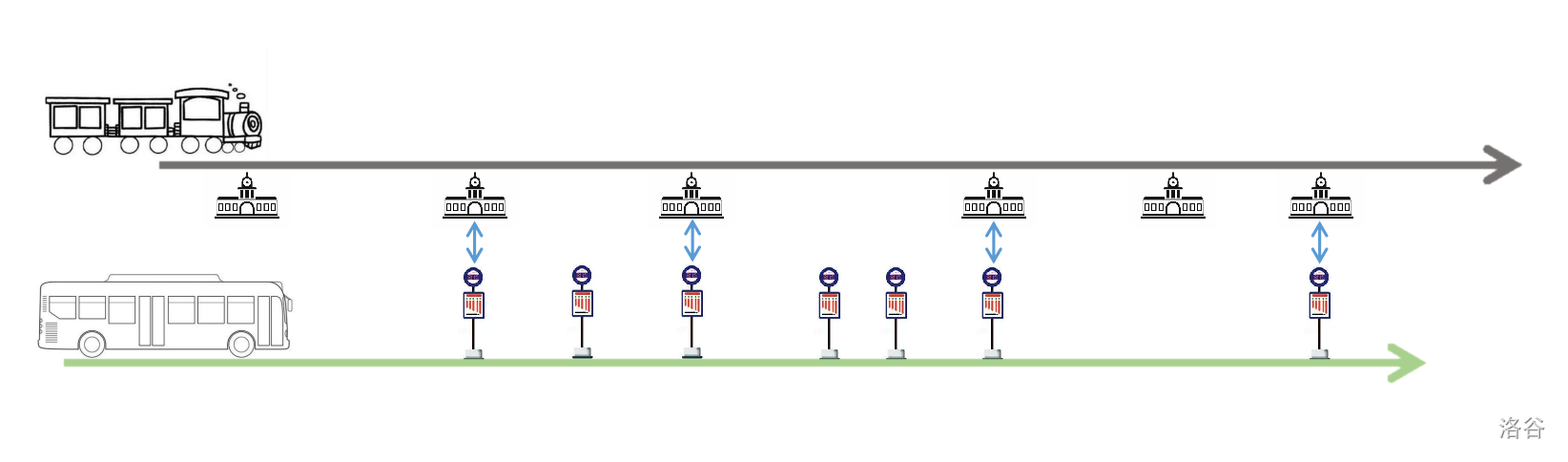
The figure shows transfer stations (blue arrows) where railway passengers can switch to buses. We focus only on transfer stations in this problem.
Problem Description
To handle peak-hour crowds, the bus company will deploy buses along a route with transfer stations (numbered 1 to west-to-east). Each transfer station has a priority value . The travel time from station to is (ignoring stop time). The railway arrives at station at time . Bus travel time between stations is always ≥ railway travel time.
You must schedule buses such that:
- All passengers arriving at any station at can board a bus (bus arrival time ≥ ).
- For each station , the dissatisfaction is calculated as:
(waiting time for the first bus) × (priority of the bus's origin station).
If multiple buses arrive simultaneously, passengers choose the one with the smallest .
Minimize the total dissatisfaction across all stations for multiple queries with different and .
Input Format
First line: Integer (number of stations).
Second line: integers (travel times).
Third line: integers (priorities).
Fourth line: Integer (number of railway schedules).
For each schedule:
- Line 1: integers (railway arrival times).
- Line 2: Integer (number of queries).
- Line 3: integers (bus counts to test).
Output Format
For each schedule, output integers—the minimal total dissatisfaction for each .
3
3 4
6 2 1
2
1 3 7
2
1 2
2 3 5
3
1 2 4
12 0
36 4 0
6
2 2 2 2 3
13 12 15 9 3 1
3
5 7 9 11 12 13
4
1 2 4 8
3 4 5 7 8 10
3
2 4 5
1000000 1000001 1000002 1000003 1000004 1000005
2
1 3
52 6 0 0
49 3 0
208 31
Hint
【Data Range】
Constraints:
- ,
- , ,
Subtasks:
| Subtask | | | | | Special | Points |
|---------|-----|-----|-------|------------|---------|--------|
| 1 | 15 | 1e3 | 1e3 | 15 | None | 5 |
| 2 | 15 | 1e6 | 1e6 | 1e6 | None | 5 |
| 3 | 100 | 1e6 | 1e6 | 1e6 | None | 15 |
| 4 | 1e3 | 1e6 | 1e6 | 1e6 | A | 5 |
| 5 | 1e3 | 1e6 | 1e6 | 1e6 | B | 30 |
| 6 | 1e3 | 1e3 | 1.1e3 | 1e3 | None | 10 |
| 7 | 1e3 | 1e6 | 1e6 | 1e6 | None | 30 |
- Special A:
- Special B:
【Sample Explanation】
Below are feasible optimal bus scheduling plans for the sample queries. Note that there may be multiple valid optimal solutions.
For the first schedule in Sample 1:
-
When :
A bus departs station 1 at time . Operational details:
| | Station 1 | Station 2 | Station 3 |
| :-------------------: | :-------: | :-------: | :-------: |
| Railway Arrival Time | | | |
| Bus Service 1 Arrival | | | |
| Boarded Service | Service 1 | Service 1 | Service 1 |
| Waiting Time | | | |Service 1 starts at station 1 (). Total dissatisfaction:
-
When :
Buses depart station 1 at and station 2 at . Operational details:
| | Station 1 | Station 2 | Station 3 |
| :-------------------: | :-------: | :-------: | :-------: |
| Railway Arrival Time | | | |
| Bus Service 1 Arrival | | | |
| Bus Service 2 Arrival | — | | |
| Boarded Service | Service 1 | Service 2 | Service 2 |
| Waiting Time | | | |Service 1 starts at station 1 (), Service 2 at station 2 (). Total dissatisfaction:
For the second schedule in Sample 1:
-
When :
A bus departs station 1 at . Operational details:
| | Station 1 | Station 2 | Station 3 |
| :-------------------: | :-------: | :-------: | :-------: |
| Railway Arrival Time | | | |
| Bus Service 1 Arrival | | | |
| Boarded Service | Service 1 | Service 1 | Service 1 |
| Waiting Time | | | |Total dissatisfaction:
-
When :
Buses depart station 1 at and station 2 at . Operational details:
| | Station 1 | Station 2 | Station 3 |
| :-------------------: | :-------: | :-------: | :-------: |
| Railway Arrival Time | | | |
| Bus Service 1 Arrival | | | |
| Bus Service 2 Arrival | — | | |
| Boarded Service | Service 1 | Service 2 | Service 2 |
| Waiting Time | | | |Total dissatisfaction:
-
When :
Buses depart:- Station 1 at and .
- Station 2 at and .
Operational details:
Station 1 Station 2 Station 3 Railway Arrival Time Bus Service 1 Arrival Bus Service 2 Arrival Bus Service 3 Arrival - Bus Service 4 Arrival Boarded Service Service 2 Service 4 Service 3 Waiting Time Services 1/2 start at station 1 (), Services 3/4 at station 2 (). Total dissatisfaction:
Note: At Station 3, Services 1 and 3 arrive simultaneously at . Passengers choose Service 3 (lower ) over Service 1 ().